
A capable model can still be unfamiliar with a company. It has to discover how records connect, where an answer lives and which tools will get it there. If that knowledge disappears after every run, the next question starts with the same learning curve.
Working with Eon, we studied whether an agent could turn that experience into a reusable skill. We gave it a readable guide to a synthetic company, then improved the guide from its execution traces. The answering model stayed the same.
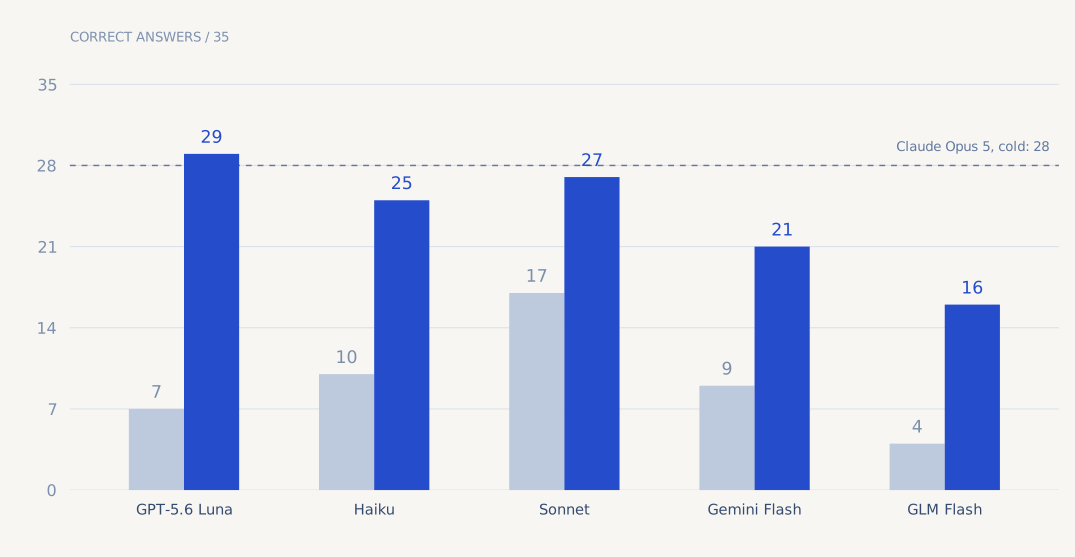
On our 35-question development suite, GPT-5.6 Luna went from 7 to 29 correct answers. That was one answer above the historical cold reference for Claude Opus 5, at 28. The improvement came from the skill the agent used to work with the company.
The same model, with more useful experience
FIGURE 1 / ERAGON × EON
Learning the company changes the result.
Correct answers out of 35, before and after skill evolution.

Every model in this comparison improved with an evolved skill. Luna made the largest gain: 22 additional correct answers, moving from 20.0% to 82.9% on the suite. Haiku rose from 10 to 25; Sonnet from 17 to 27; Gemini Flash from 9 to 21; and GLM Flash from 4 to 16.
The comparison asks a specific question: how much can an agent improve when it learns to use a particular company’s environment? It does not establish a general ranking of these models.
A synthetic company with connected systems
Eon’s Era supplied Fairhaven Group, a synthetic enterprise with records spread across Salesforce, HubSpot, Zendesk, Jira and Confluence, Slack, and Gong. The environment gives agents systems to work in, rather than a document containing all the answers.
We used 35 read-only business questions, graded deterministically without partial credit. This makes the result concrete: an answer either met the task’s requirements or it did not.
The company is synthetic, but the work has a familiar shape. An answer may depend on information held in several systems. Finding it requires knowing what to query, how to follow a relationship and when the available evidence is sufficient.
A skill that learns from execution
The starting point was a human-authored guide to the company. It gave the agent a way to approach the environment. We then used GEPA, a method for evolving prompts through reflection on execution traces, to improve that guide.
The loop reads what the agent actually did: the tools it called, the information it received, where it went wrong and the feedback on its answer. It proposes changes to the skill and evaluates the resulting behavior. Useful changes become part of the guide for subsequent runs.
FIGURE 2 / THE LEARNING LOOP
The work becomes a better way to work.
- 01Run
Answer a business question with the current skill.
- 02Inspect
Read the trace and the grading feedback.
- 03Revise
Improve the guide from what the run revealed.
- 04Evaluate
Test the revised skill and retain useful changes.
This puts the learning somewhere the company can inspect and keep. A skill can be read, reviewed, versioned and used again. The knowledge acquired while doing one task becomes a better starting point for the next.
Learning once, answering repeatedly
There are two costs to distinguish: producing the skill and using it.
for Luna’s evolved skill
with that skill
The learning run cost $8.54. Once produced, Luna’s skill could be reused at an answering cost below one cent per attempted question in this experiment. The learning cost is separate from that figure; it should be included when calculating the economics of a deployment.
A skill becomes more useful economically as it serves more work, provided the quality holds. That is why both the cost of improvement and the quality of subsequent runs matter.
What this result establishes
The result shows a substantial improvement on this development suite from changing the agent’s skill while keeping the answering model fixed. It also shows why the system around a model matters: a smaller model with a useful guide can perform strongly in a company-specific environment.
The evaluation has clear limits:
- The suite includes optimization questions. These scores measure performance on the development environment, not generalization to an unseen test set.
- The cold baselines are historical references. Luna’s 29 is above Opus 5’s reference of 28, but a one-question gap is not evidence of broad model superiority.
- The scope is narrow. There are 35 read-only questions in one synthetic company. The result does not establish performance across real companies, write actions or long-running production work.
- Cost depends on reuse. The answering figure excludes the one-time learning run, and deployment economics depend on how often the skill is used and updated.
The intelligence belongs to the company
The direction we care about is straightforward. Agents should finish a task with more than an answer. They should leave behind something that makes the next task easier: a better method, a corrected assumption or a clearer understanding of the company.
This experiment puts that idea into a measurable loop. Run the work. Inspect what happened. Improve the skill. Evaluate it again. The model provides capability; the company accumulates experience.
That is the foundation of Learning in Eragon: every run is an opportunity to build intelligence you can keep.
Research with Eon, using the Fairhaven Group environment supplied through Era. Results and cost figures are from Eragon’s experiment. Method reference: Agrawal et al., GEPA: Reflective Prompt Evolution Can Outperform Reinforcement Learning.